
Woven vs. knotted
The first hand-made rugs in the Orient came about because people were looking for comfort and warmth - they gave shelter from the hot sun and made sitting and eating on the floor more pleasant. Before long, though, they were more than just a practical companion – they grew into precious works of art that brought beauty, tradition and trade together.
Handmade rugs essentially fall into two groups: woven and knotted rugs .
By now there are a few further production methods (tufting or loom, for instance) that emerged in response to falling expectations of a rug's durability and quality. Here, though, we'll stick to the two most original and traditional kinds of rug.
 HAND-WOVEN RUGS
Compared with knotting, weaving takes considerably less material and time. That is why woven rugs were widespread very early on and are regarded as the forerunners.
In weaving, the warp threads – the vertical foundation threads that give the rug its firmness – are first tensioned on a loom .
Then the weft thread – the thread that determines the rug's pattern and stability – is passed by hand alternately over and under the warp threads.

A distinctive feature of hand-woven rugs is that they have no pile – which means that, unlike hand-knotted rugs, they have no raised, fluffy surface but feel flat and rather coarse to the touch.
Depending on the province and the rug's intended use, various weaving techniques have developed.
The most traditional technique produces a flat, firm pile that is usable on both sides , as front and back look exactly the same. And that is precisely what you get with a Kelim rug - you're bound to have heard of one before!
One special kind of Kelim is the slit-weave Kelim. In earlier times it was used to keep out the heat of the sun while still making the most of the daylight. In a slit-weave Kelim the weft thread is not carried across the full width of the rug but only as far as the colour boundary, after which it runs back again. So a slit always appears where a new colour begins.
The slits that let the light through also give the patterns a special accent.

We love how beautifully the sun and this enchanting Kelim come together.
Besides this best-known classic among woven rugs, there are also wonderful pieces such as Aubusson / Gobelin, or Soumak rugs.

HAND-KNOTTED RUGS
Hand-knotted rugs are made on a special frame, the so-called knotting loom . Depending on the width the rug is meant to have, it is set up individually every single time.
Just as in weaving, the first step is the vertical warp threads are first mounted on the knotting loom and pulled taut. It is very important that they stay tight, so the rug does not develop waves or uneven patches later on.
Now comes the most important step:
The actual pile yarn – the part that later forms the surface of the rug – is knotted in by hand. Every single knot is pulled tight, and knot by knot the desired pattern takes shape, exactly to the design or else freely improvised.
Once a row has been completely knotted, the weave is tightened with a metal comb, to make sure the knots sit firmly in the right place and a dense structure is formed.
Next, the weft thread is woven in - alternately passed over and under the taut warp threads. In this way it gives the knots, and thus the emerging rug, extra hold and stability.
This sequence – knotting, beating down, a new weft thread – is repeated over and over, until the whole rug is finished. Depending on the size of the rug, this can be necessary hundreds or even thousands of times over!
Finally, the pile is sheared to the desired height.

The knots of a hand-knotted rug are the key to its quality and durability. Depending on the region, the design and the intended use, different types of knot have developed.
In our blog post All About Knotting we explain the typical knot types and give you an insight into how long it takes for a hand-knotted rug to be completed. Click here to find out more.
Overcasting
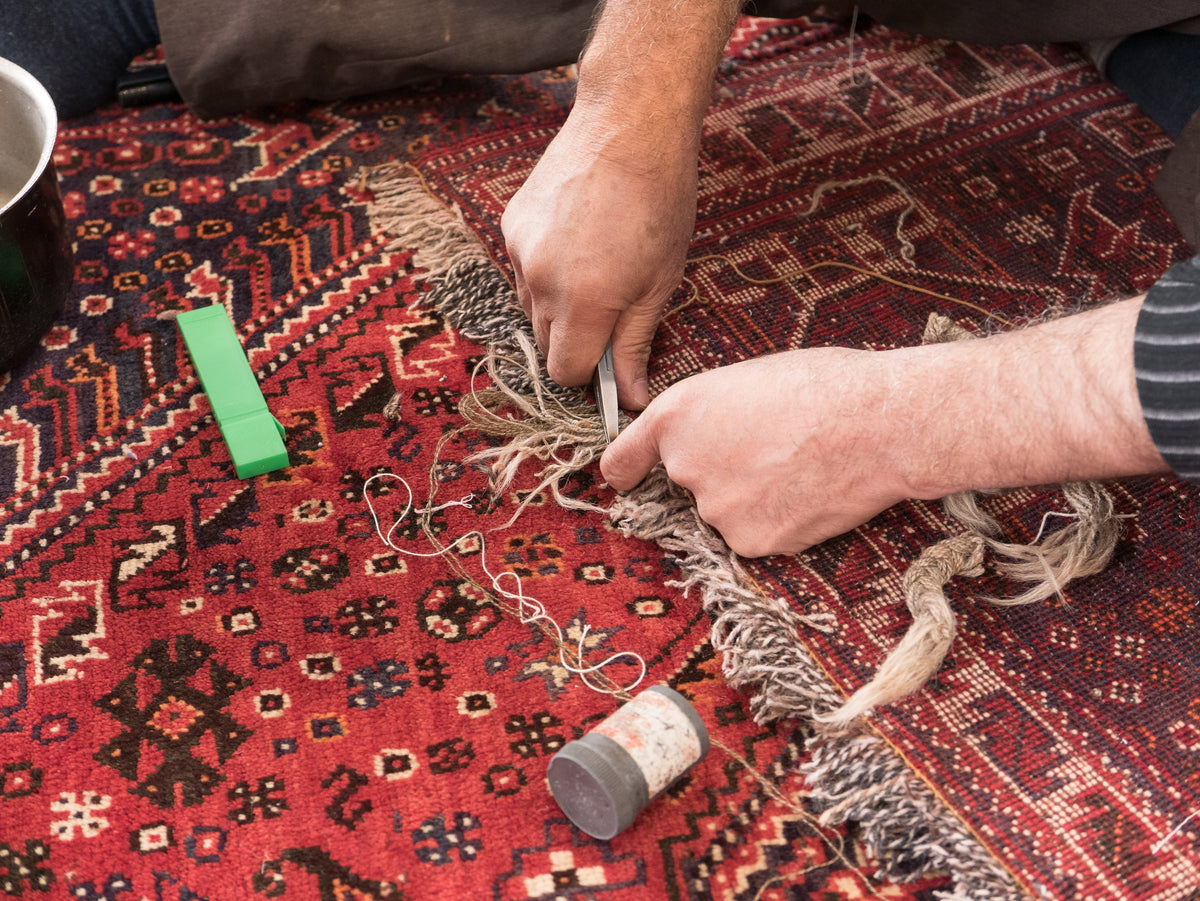
Once the rug has been cut from the loom, the edges are overcast and the fringes knotted. This keeps the rug from unravelling again.
Finishing
Finishing is the final and most important step in making a rug, yet its importance is often overlooked.
Only now does the rug's true character, its true beauty, come to light.
First the pile is sheared evenly to the desired pile height, because during knotting the yarn is left fairly long so that it can be tied into knots.
The rug is then given at least one nourishing natural-soap wash.

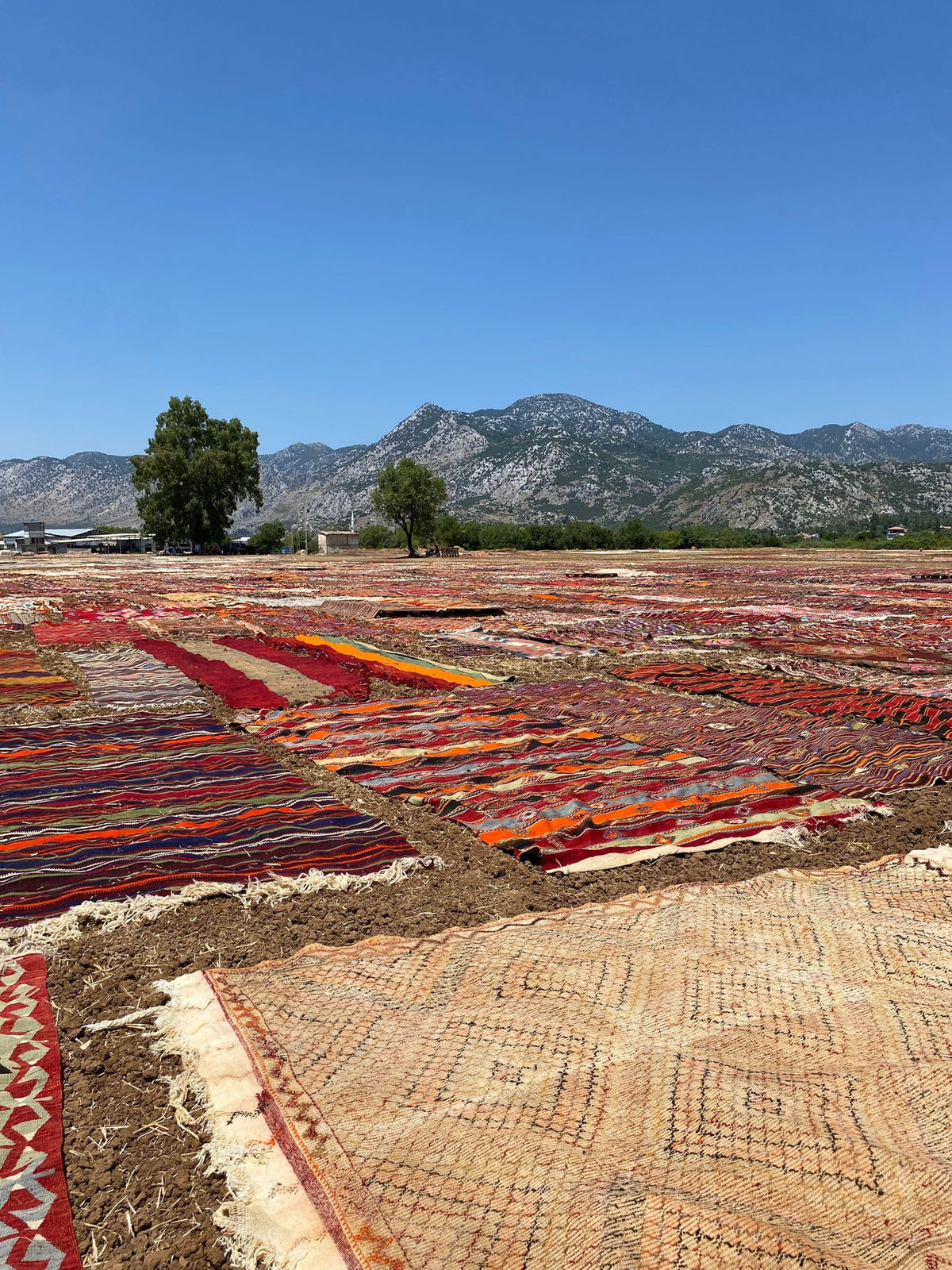
To dry it and to set the colours, the rug is laid out in the sun - and this is how the rug's beautiful sheen develops in an entirely natural way.
Now different pile heights can be worked in by hand with scissors, bringing out particular patterns and areas of the rug. This 3D effect is frequently found in our designer rugs .


