
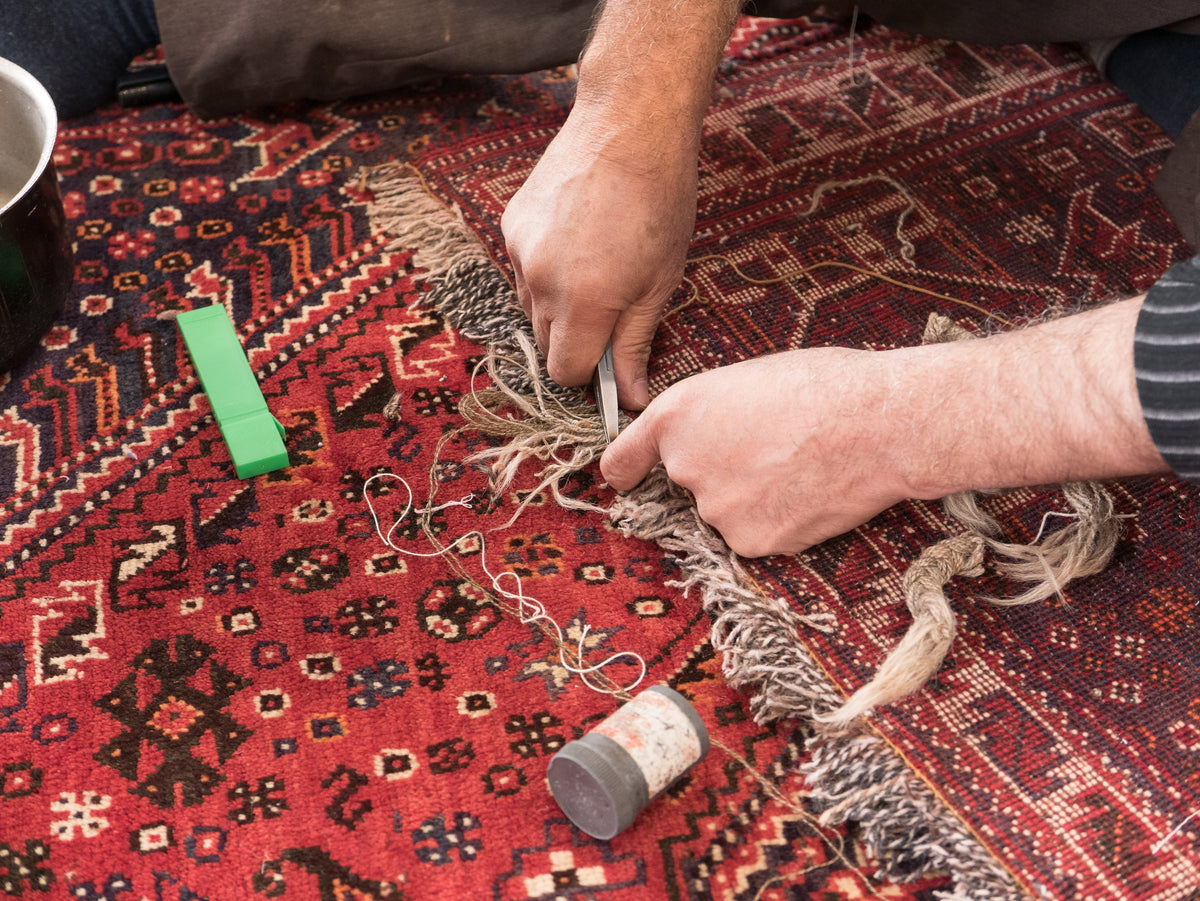
Hand-knotted Ziegler and Farahan rugs in hand-spun wool
A Ziegler rug is a hand-knotted rug with classic Persian patterns, today usually made in Pakistan or India from hand-spun wool dyed with plant-based colours. The colours range from light, restrained tones to strong, richly coloured pieces. The name goes back to the firm of Ziegler & Co.: a Swiss merchant founded it in Manchester in 1883 and had rugs knotted in Sultanabad, today's Arak in Iran, to Western specifications for colour and pattern.
Ziegler and Persian rugs compared
| Ziegler | Classic Persian | |
|---|---|---|
| Origin today | usually Pakistan, India | Iran |
| Pattern | Persian, floral vines, generously drawn | depending on provenance, often a medallion and dense ornament |
| colours | from light and restrained to strong and colourful | often strong red, blue, ivory |
| wool | hand-spun, plant-based dyes | depending on quality |
| Look | versatile, from calm to lively | classic, opulent |
| Price with us | around €500 per m² | depending on provenance and fineness |


Ziegler? That doesn't sound very Oriental!
True – it isn't!
In 1883, a Swiss merchant in Manchester, England, founded an English import company called Company Messrs. Ziegler & Co. Ltd. and at the same time opened a rug manufactory in Sultanabad (today Arak, Iran) in the Mahallat region.
The rugs known as Ziegler-Mahal or simply Ziegler were knotted there according to Western colour and pattern specifications . The blend of European design briefs in a lighter, calmer palette and classic patterns in the style of Farahan and Sultanabad rugs went down – and still goes down – very well in Europe.

A dear child has many names
Farahan = Mahal = Ziegler
Farahan and Mahal are often used as synonyms for Ziegler rugs. That's because at the Ziegler company, rugs with the traditional Mahal- or Farahan pattern were originally knotted.
Harmonious & Yet Lively


Ziegler & Farahan rugs


Traditional Techniques Rediscovered
A Success Story
In the years after 1883, Zigler rugs became a huge success in Europe and an international mark of quality.
Well-preserved antique Ziegler rugs fetch record prices at auction today – above all in the USA. For some years now these antique Ziegler designs have been re-knotted to a very high standard in Pakistan or India.
The newly released Ziegler rugs made from hand-spun wool dyed with natural dyes are part of a revival of hand-knotted rugs. The return to traditional techniques began in the early 1980s, driven among other things by the so-called DOBAG initiative. The same traditional technique is now also used for Mamlouk and Bakhtiari rugs.


Ancient Egypt made new
Mamlouk
Mamlouk or, less commonly, Mamluk rugs, were knotted in Egypt above all in the 15th century and are today found almost exclusively in museums.
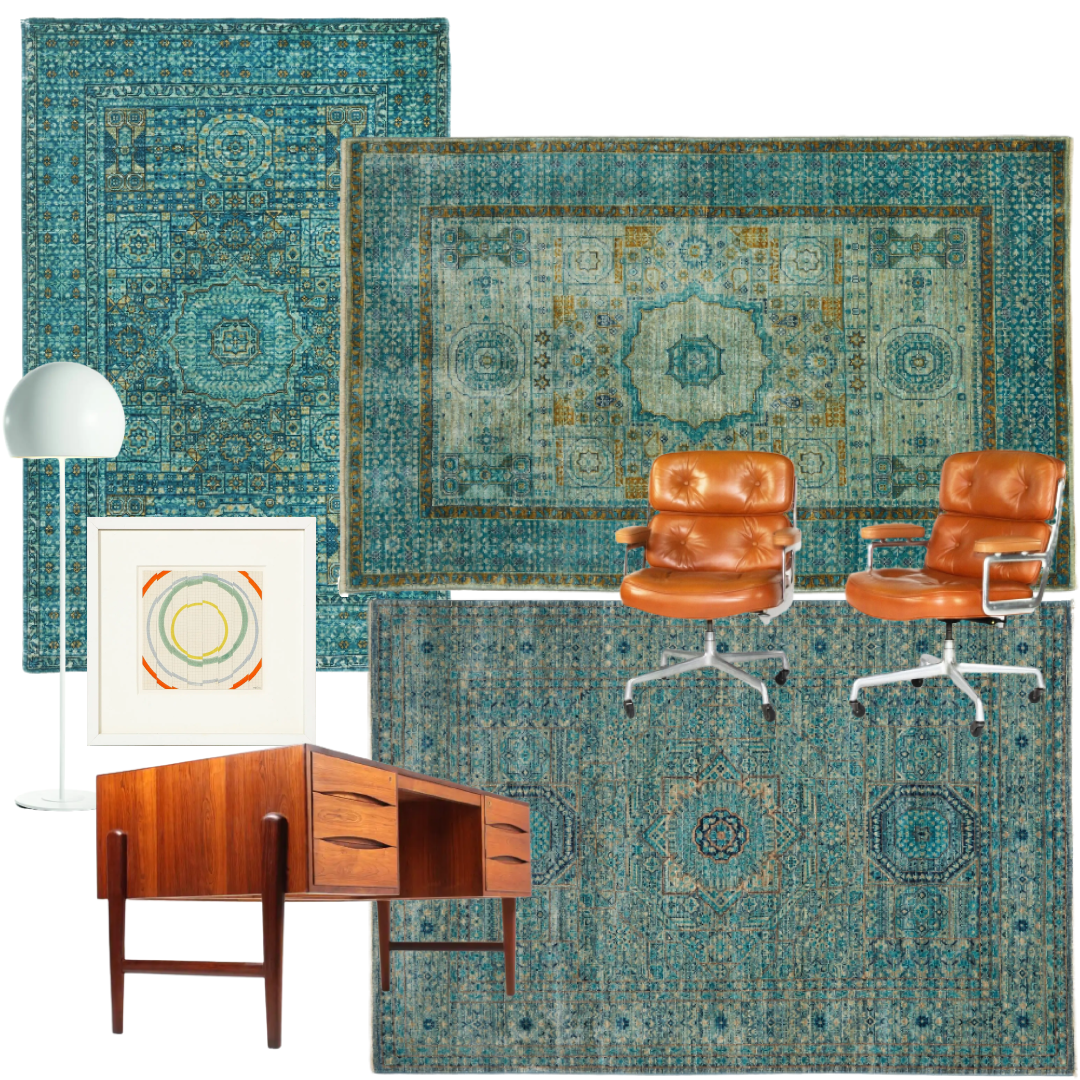
Our Mamlouk rugs are a reinterpretation of the classic pattern, which is characterised by a wealth of different geometric shapes that give the rug a kaleidoscopic effect.
Mamlouk


Getting work done right


A homage to nature
Tuja
The Tuja rugs are adorned with elements of the tree of life. We have developed two versions of the Tuja motif: in one, various Tuja motifs appear scattered across the rug as if at random. In the other, individual tendrils and leaves are arranged in lengthwise stripes of different colours, framed by a monochrome border. Our Tuja rugs are tuned to contemporary taste throughout: harmonious colour compositions in natural shades flatter the variations of the traditional pattern. Another characteristic feature is that the fringes – as with our Oxiana rugs – have been gathered into small bundles and wrapped with threads in different colours.

Lots of cheerful colours
Oxiana
The pattern of the hand-knotted Oxiana rugs draws on traditional Uzbek patterns. Originally it was above all the region around Samarkand and Oxiana that knotted rugs with a similar pattern. Our Oxiana rugs are tuned to contemporary taste: harmonious colour compositions in natural dyes flatter the traditional pattern. The Oxiana rugs are graced by colourful cross stripes that alternate with imaginatively patterned areas. The patterned sections show geometric compositions reminiscent of a Kazak pattern. Another characteristic is that the fringes were gathered into small bundles and wrapped with threads in different colours.
Featured collection
Oxiana rugs


From south-western Iran
Bakhtiari
The Bakhtiari (also spelled Bachtiaren in German) are an ancient people with many branches, living in south-western Iran. The collective name for their rugs is Bakhtiar or Bakhtiari, where the “i” stands for our preposition “of”. Bakhtiari rugs – the rugs of the Bakhtiari – cover numerous sub-provenances with a range of pattern types. Despite this wide repertoire, Bakhtiar rugs resemble one another in their colour compositions, in their various weaving techniques and in their design language, which is always floral.
Bakhtiari rugs are made mainly with natural dyes, which feel pleasant despite their intensity and take on a beautiful patina over the years. Frequently used colours are brown for the outlines, plus red, bottle green, yellow and white as a highlight that gives the rug its likeable character.
Featured collection
Bakhtiari rugs with panel patterns


Who a Ziegler is right for
- If you like Persian patterns and want a choice of colour, from restrained to vibrant.
- For modern homes: a Ziegler in light tones feels calmer than a strongly coloured Persian.
- For heavily used rooms, because hand-spun new wool is very hard-wearing.
- For hallways, because Ziegler come in many runner sizes.
FAQ
Frequently asked questions
From the English import house Ziegler & Co., founded in 1883 by a Swiss merchant in Manchester. It ran a rug manufactory in Sultanabad (today Arak, Iran). The rugs knotted there, with their lighter, calmer colouring, became known as Ziegler or Ziegler-Mahal
Both are knotted in the same way. Ziegler show floral Persian patterns, Kazak geometric patterns in the Caucasian tradition. That is why you will find them together in one collection with us: Ziegler & Farahan rugs, Kazak, Mamlouk & Co.
Not in the strict sense. Persian rugs come from Iran, while new Ziegler are mostly made in Pakistan or India today. The patterns are Persian, though, and the first Ziegler really were knotted in Iran.