
rug glossary
Warp, Lah, Boteh or nap: the world of hand-knotted rugs comes with a good many terms. Here we explain the most important ones briefly and clearly. You will find more detail in our Guide and in the frequently asked questions.
A
All-over design
Rugs with a motif that repeats across the whole field are also described as all-over patterned or all-over design. The counterpart is a pattern arranged around a central medallion. More in our guide Pattern.
Old
We rate rugs with 40 to 99 years behind them as old. To the old and antique rugs.
Antique
Rugs that are at least 100 years old count as antique and are collector's pieces. To the old and antique rugs.
Aubusson, Tapestry & Needlepoint
Flat wool rugs without a pile, either woven like a wall hanging (Aubusson, tapisserie) or embroidered by hand (needlepoint). Floral patterns, medallions and pastel colours after French models are typical. To the collection
B
Bakhtiari
Hand-knotted rugs with their characteristic compartment patterns. Today they are also knotted in the same traditional technique as Ziegler and Mamlouk. To the collection
Beni Ourain
Particularly popular Moroccan Berber rugs, traditionally made by hand by Berber tribes in the Atlas Mountains. To the Beni Berber rugs
Berber rug
The Berbers are a nomadic people who have lived in North Africa for several thousand years. Moroccan Berber rugs are hand-knotted from natural sheep's wool and their long pile makes them unusually soft. They are knotted without any industrial template; the typical base patterns have been passed on from family to family for generations. To the collection
Bijar
Bijar lies in the province of Kermanshah in north-western Iran. In the Kurdish Bijar a particularly thick, hard weft yarn is beaten in. The result is a board-hard rug that is exceptionally hard-wearing. More recent Bijars often show the Herati pattern. To the collection
Boteh
A curved, almond-shaped motif that stands upright and is recognisable by its bent-over tip. Alongside the Herati pattern, it is the most widespread Oriental rug pattern, above all on Caucasian and Persian rugs. In Europe it gave rise to the paisley pattern.
C
CARE & FAIR
The industry-wide relief initiative “CARE & FAIR – the rug trade against child labour” was founded in 1994. Zomorrodi Teppiche is a member. More on this
Chinese Rugs
Hand-knotted rugs from China with a few clearly placed motifs such as dragons, vases, peonies or lotus flowers on calm fields of colour, inspired by the porcelain of the Ming and Qing dynasties. To the collection
G
Gabbeh and Lori
Hand-knotted nomad rugs from southern Iran with a high, soft wool pile and deliberately simple patterns: blocks of colour, stripes, small animals or figures. To the collection
Prayer niche (mihrab)
The mehrab or mihrab pattern depicts the Islamic prayer niche, which in mosques marks the direction of prayer towards Mecca. Rugs with this pattern are traditionally used for prayer.
Qom
A relatively young provenance in central Iran, around 100 km south of Tehran. Because there was no old knotting tradition there, patterns were adopted from other weaving regions. Today the silk rugs from Qom are among the most famous rugs in the world. To the collection
H
Harshang
Also known as the crab pattern. It was first used in the Khorasan district of Persia and consists of crab-like palmettes with open claws.
Herati
One of the earliest rug patterns: a diamond shape with floral motifs at the corners, framed by lancet-shaped leaves, sometimes also called Mahi (Persian for fish). It is still knotted in almost all Persian weaving centres today.
High pile
Rugs with a pile height of more than 15 millimetres. They feel especially soft.
K
Kazak
Rugs modelled on Caucasian originals, with geometric patterns. At Zomorrodi they are made in the same way as Ziegler: hand-knotted from hand-spun wool with vegetable dyes. To the collection
Kelim
The word comes from the Turkish “Kilim”, but it has its origin in Persian – in “Gelim”, which means something like flat woven textile. What is meant are rugs woven very flat and made entirely by hand. The weft thread forms the pattern on both sides, which is why most Kelims can be used either way up. To the collection
Kilim cushions and rug cushions
Cushion covers whose front is made from fragments of hand-woven Kelims or hand-knotted rugs. To the collection
Keshan
A central Persian city (also written Kashan or Keschan) between the Zagros Mountains and the Persian deserts. The pile of Keshan rugs is typically knotted from extremely soft wool, which makes it particularly dense. To the collection
Warp, weft and fringes
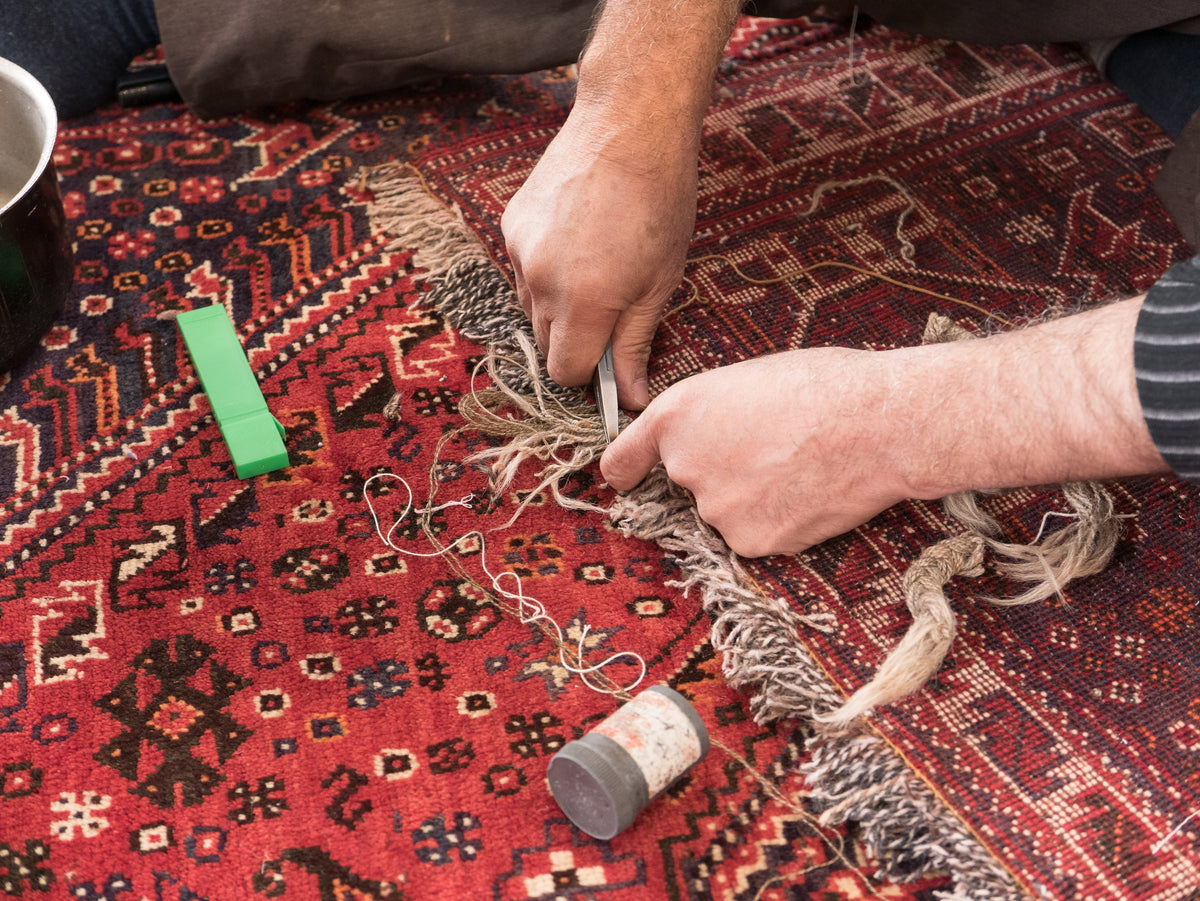
Technically speaking, the fringes of a rug are nothing other than the warp threads protruding at the two ends. They therefore tell you which warp material was used. In a Kelim, the pattern is created by the coloured weft threads woven into the warp threads.
Knot density
The number of knots per m². Along with the material, it determines the quality of a hand-knotted rug. At Zomorrodi, the knotting ranges from around 160,000 up to 360,000 and more knots per m². You can see the fineness in the details: flowing vines instead of stepped lines, delicate blossoms in the borders. All about knotting
Short pile
Rugs with a pile height of less than 15 millimetres. They are hard-wearing and easy to clean.
L
Lah
A quality grading for Nain rugs, Persian for ‘layer’. Lah describes the number of threads twisted together to form the warp. The more threads, the thicker the warp and the knots, and the lower the knot density.
runner
A rug that is considerably longer than it is wide, typically around 80 × 300 cm. It follows a route you walk: the hallway, the kitchen counter, the path between bed and wardrobe. Browse the runners
Tree of Life
A widespread motif representing eternal life. The tree grows up from the base of the field and symbolises the connection between heaven, earth and the underworld.
M
Mamlouk
Mamlouk (less commonly Mamluk) rugs were knotted in Egypt above all in the 15th century and are today found almost only in museums. The new Mamlouk rugs are a reinterpretation of the classic pattern with its many geometric forms. To the collection
medallion
A central motif around which the pattern is arranged symmetrically. It usually sits in the middle of the rug; less often, several medallions are placed one above the other. Found in rug patterns since about the 16th century.
N
Nain
One of Iran's best-known rug provenances, north-west of Isfahan. The ground colours are mostly white or beige and blue; floral patterns whose outlines are accented with silk are typical. The quality is given in Lah. To the collection
Natural dyes (plant dyes)
Many rugs, Kelims and cushions are coloured with natural dyes. If the wool becomes damp they can bleed a little, and direct sunlight can fade them.
O
Oriental rug
A hand-knotted rug from the Orient, above all from Persia (Iran), the Caucasus, Turkey, Afghanistan, Pakistan, India and China. Flat-woven Kelims have their own collection at Zomorrodi. To the collection
P
Paradise garden
A pattern typical of the Safavid era: a stylised depiction of a traditional Persian garden with plants, trees and watercourses that divide the garden into four sections.
Persian rug
An Oriental rug from Iran. The term refers to the traditional, finely knotted rugs from Iranian provenances such as Isfahan, Nain, Tabriz, Qom, Keshan, Mashad or Sarough. To the collection
Pictorial rug
Rugs with pictorial motifs instead of abstract patterns, such as hunting scenes, scenes of courtly life or mythical subjects. Finer rugs allow more precise depictions.
Provenance
The source, the origin of a rug. Persian rugs are usually named after their provenance, for example Nain, Tabriz or Qom.
R
Restored and unrestored
At Zomorrodi, pre-owned rugs are cleaned and sold with an honest description of their condition: unrestored, restored or as good as new. Deliberately, not all of them are restored, because worn patches and damaged fringes tell the story of a rug.
S
Slit-weave Kelim
Because a Kelim uses a new weft thread for every new colour, a narrow slit forms in the weave between two areas of colour. That is why these Kelims are also called slit-weave Kelims.
Silk Rugs
A hand-knotted rug whose pile consists entirely or largely of natural silk. Silk allows an extremely fine knotting, luminous colours and that characteristic sheen which shifts with the angle of the light. To the collection
Custom sizes and oversized rugs
Rugs that fit no standard size: oversized pieces from about 400 × 300 cm, very long gallery rugs, narrow special formats and dimensions that fall between the standard sizes. To the collection
Pile direction
The direction in which the pile lies. Depending on whether the light falls with or against the pile, the colours look different. That is why a rug looks different in photos taken from different angles.
T
Tabriz
A city on the northern border of Persia, a melting pot of cultural influences since time immemorial. It is best known for the classic Tabriz medallion rugs with their large-format medallions and floral spirals. To the collection
U
Upcycled rug
Rugs made from material that already exists: patchwork rugs from fragments of old Oriental rugs, and outdoor rugs hand-woven from recycled PET bottles. To the collection
V
Vintage
Pre-owned rugs from about 20 years old, mostly from the 1950s to the 1980s, with patina and soft colours. For us, vintage describes a style above all: some pieces are sheared, stripped of colour or re-dyed and so take on a modern look. Browse the vintage rugs
Z
Ziegler, Farahan and Mahal
In 1883, a Swiss merchant founded the company Ziegler & Co. in Manchester and opened a rug manufactory in Sultanabad (today Arak, Iran). There, rugs were knotted to Western specifications for colour and pattern, lighter and calmer than classic Persians. Today Ziegler comes in pale shades as well as in strong, colourful ones. Because Ziegler originally knotted the traditional Mahal or Farahan pattern, the three names are often used interchangeably. To the collection