


Indian Bijar | 246 x 80 cm | Nr. Z-3592
Due to US sanctions, PayPal is not available for Persian rugs. You can use all other payment methods.


|
14-day home trial |

|
Free delivery & returns within the EU |
Indian Bijar
This one-of-a-kind piece in red brings together traditional craftsmanship and timeless elegance. With a knot density of around 300,000 knots per m², the painstaking workmanship shows above all in the precise drawing of the pattern and the fine detailing. At 246 × 80 cm it works well as a hallway runner. It also cuts a fine figure in the kitchen in front of the worktop. The harmonious colouring and the distinctive texture lend any room an exclusive, homely atmosphere. A rug of this quality is far more than a piece of furnishing – it is a piece of traditional textile art with individual character and lasting value.
| Availability | In stock | Delivery time: 1–3 working days |
| Origin | India |
| Dimensions | 246 cm x 80 cm (= 1.97 m²) |
| Construction | hand-knotted |
| Material |
Pile: wool with pure silk Weft & Warp: cotton |
| knots | 300,000 knots |
| Pile height | 10 mm |
| Year of manufacture | 2015 |
| Condition | pre-owned, but in very good condition (cleaned & restored) |
| Colour | Red |
| Edition | one-of-a-kind piece |

Origin
This rug was knotted in Bijar, in the province of Kermanshah in north-western Iran. Bijar rugs are among the sturdiest and finest Oriental rugs. The majority of the population in Bijar are Kurds.In the Kurdish Bijar, a particularly thick and extremely hard weft yarn is beaten into the weave. The result is a board-stiff rug that is exceptionally hard-wearing. The younger Bijars in particular are decorated with the typical Herati pattern, also known as the fish pattern.
The pattern of this rug is inspired by the patterns of classic Indian Bijars. This particular rug, however, was knotted in India.
Exactly when rug production in India began is unknown. The first rugs in India were probably made during the cultural flowering of the Mughal dynasty in the middle of the 16th century. In the middle of the 19th century, with the decline of the Mughal dynasty, Indian rug production fell into crisis. European companies whose only aim was export to the West took the place of the traditional court manufactories. Very similar rugs were produced in different towns, and standardisation set in. Today, the designs of hand-knotted Indian rugs can scarcely be attributed to individual regions. Instead, the workshops have come to specialise in rendering European and traditional Iranian designs adapted to Western taste. In terms of quality, rugs from India benefit from the long tradition of craftsmanship and the high quality of Indian materials.
Material
The pile of this Indian Bijar was hand-knotted from high-quality new wool. New wool is obtained by gently shearing sheep. The pattern has been worked in pure silk, so that the colours of this Indian Bijar's design glow in varying shades depending on how the light falls. New wool is a renewable, natural raw material with a whole range of impressive qualities: thanks to the natural lanolin in the wool, the surface repels droplets of water and is therefore naturally protected against dirt. Wool also offers excellent thermal insulation, helps regulate the indoor climate and absorbs sound. Silk is harvested by hand from the cocoons of the silk moth. Because the individual silk filaments are extremely long, very fine yarns can be spun that are light in weight yet still strong. This fine yarn allows smaller knots to be tied and thus finer patterns to be created. That is why the finest rugs in the world are hand-knotted from pure silk.The weft and warp threads of this Indian Bijar are made of cotton. This versatile material is both tear-resistant and elastic, which makes it particularly well suited to a hard-wearing foundation.
Condition
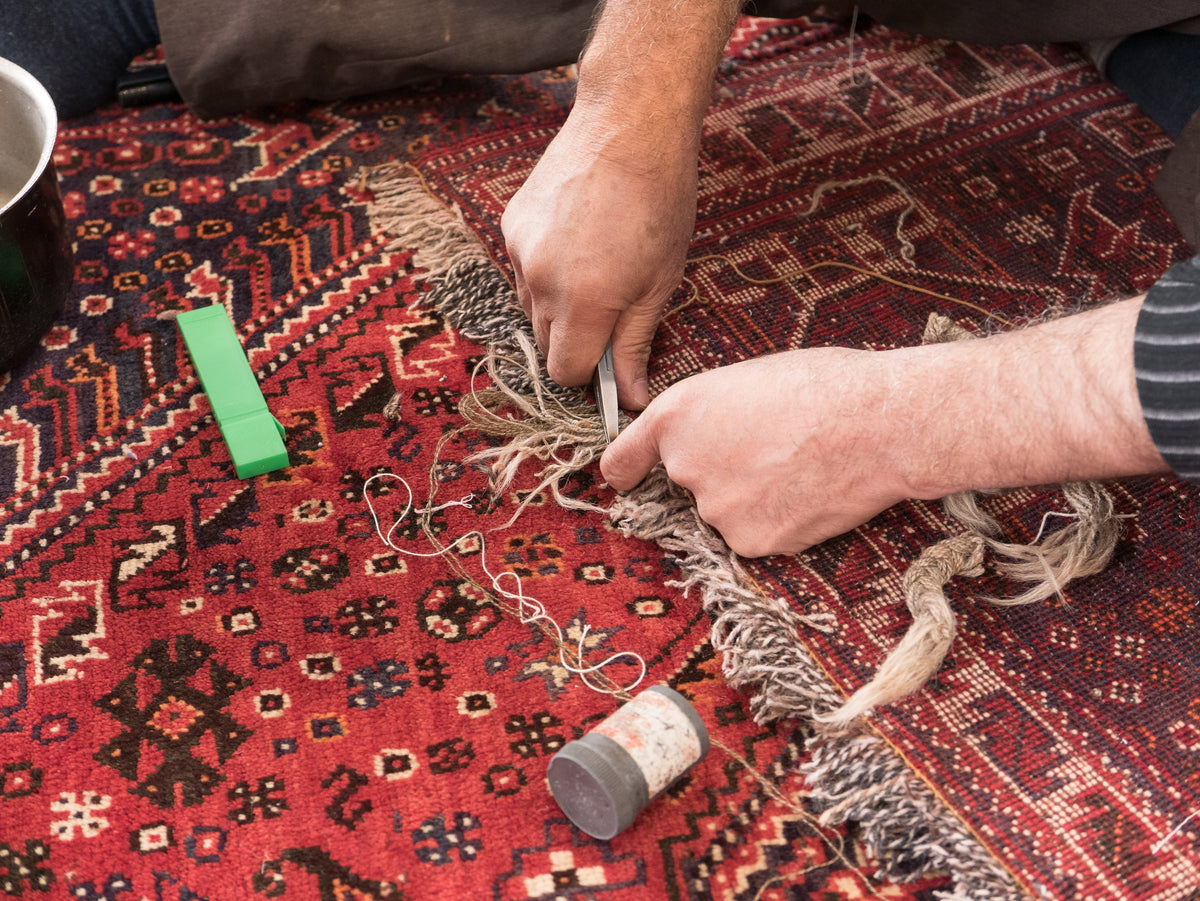
This Indian Bijar has a history. It was knotted around 2015. We have cleaned it thoroughly and restored it with care. Despite its age, it is therefore in very good condition.
A note on the photos
Child labour? No thanks.

The rug trade against child labour: Children belong in school, not at a knotting or weaving loom. For us it therefore goes without saying that we only offer rugs made under fair conditions and without child labour. We place particular importance on good working conditions and tolerate no child labour at our producers.
We are proud to be a member of the Care & Fair campaign against child labour.
The industry-wide campaign CARE & FAIR - the rug trade against child labour was founded in 1994. The initiative has made it its mission to fight the excesses of illegal child labour in the knotting countries and, at the same time, to improve the overall situation of rug knotters and their families in the knotting regions of India, Nepal and Pakistan.
Our goals:
- Ending illegal child labour in India and Pakistan.
- Creating better living conditions for knotters' families.
- Socially responsible production. We only accept goods that have been made under fair conditions. Working with our producers as partners, we want to make clear to them that taking on social responsibility benefits everyone.
Together with Care & Fair we currently support 10 schools, 6 adult education centres and 3 day clinics in India and Pakistan.
Choose options
Due to US sanctions, PayPal is not available for Persian rugs. You can use all other payment methods.
|
|
14-day home trial |
|
|
Free delivery & returns within the EU |