

Lori Royal | 288 x 198 cm | Nr. Z-4804


|
14-day home trial |

|
Free delivery & returns within the EU |
Mottled Lori Royal, light red with stripes
| Origin |
|
| Dimensions | 288 cm x 198 cm (= 5.7024 m²) |
| Construction | hand-knotted |
| Material |
Pile: wool (hand-spun, natural dyes)
|
| knots per m²2 | 160.000 |
| Pile height | 8mm |
| Year of manufacture | 2024 |
| Colour | Light red, light brown |
| Edition | one-of-a-kind piece |
Origin
Lori rugs are a finer version of the Gabbeh, which was traditionally knotted by the Lurs. The Lurs are a tribal people in south-western Persia (also known as Loristan). Lori (or Luri) rugs are also referred to as Loribaft. The added syllable "baft" means roughly "knotted". Translated, Loribaft therefore means Lur knotting.
Lori rugs traditionally have inventive geometric patterns in colourful designs. Modern Loris are usually plainer these days, with monochrome designs. Even so, you still come across traditional, stylised and geometric motifs from everyday nomadic life, such as goats, camels, dogs, plants or people. The geometric pattern and the friendly colours create a pleasant, warm atmosphere at home.
The pattern of this rug is adorned with horizontal stripes and flowing colour gradients. It is faintly reminiscent of the signature striped designs of the Italian fashion house Missoni.
Pattern
The surface of this Lori Royal has a mottled look. The shifts in tone and the light-and-dark shading of the pile yarn make the colours shimmer and keep the rug forgiving of dirt. These so-called colour variations, known as abrash, give the rug a livelier character. The mottling comes about because the wool of this Lori Royal was hand-spun. During dyeing, the natural pigments are absorbed to differing degrees.
The straight stripes of this Lori Royal order and structure the pattern.
The repeating elements of this Lori Royal rug have no particular centre. The recurring repeat pattern feels calming, yet never dull. Rugs with a repeat pattern are also described as all-over patterned.
The ground of this Lori Royal is golden beige. The overall impression is also dominated by light brown and light red.
Material
This particularly fine, hand-knotted Lori has an exceptionally dense pile and an even surface that is not as grainy as that of a Gabbeh or of other Lori rugs. The wool used for the pile of Lori rugs is especially high in quality and rich in natural lanolin. They are wonderfully cosy and hard-wearing. Traditionally, Lori rugs – like the Gabbeh – were used for sleeping on. They invite you to sit and sprawl out in the living room, yet they are also excellent in hallways and dining areas.
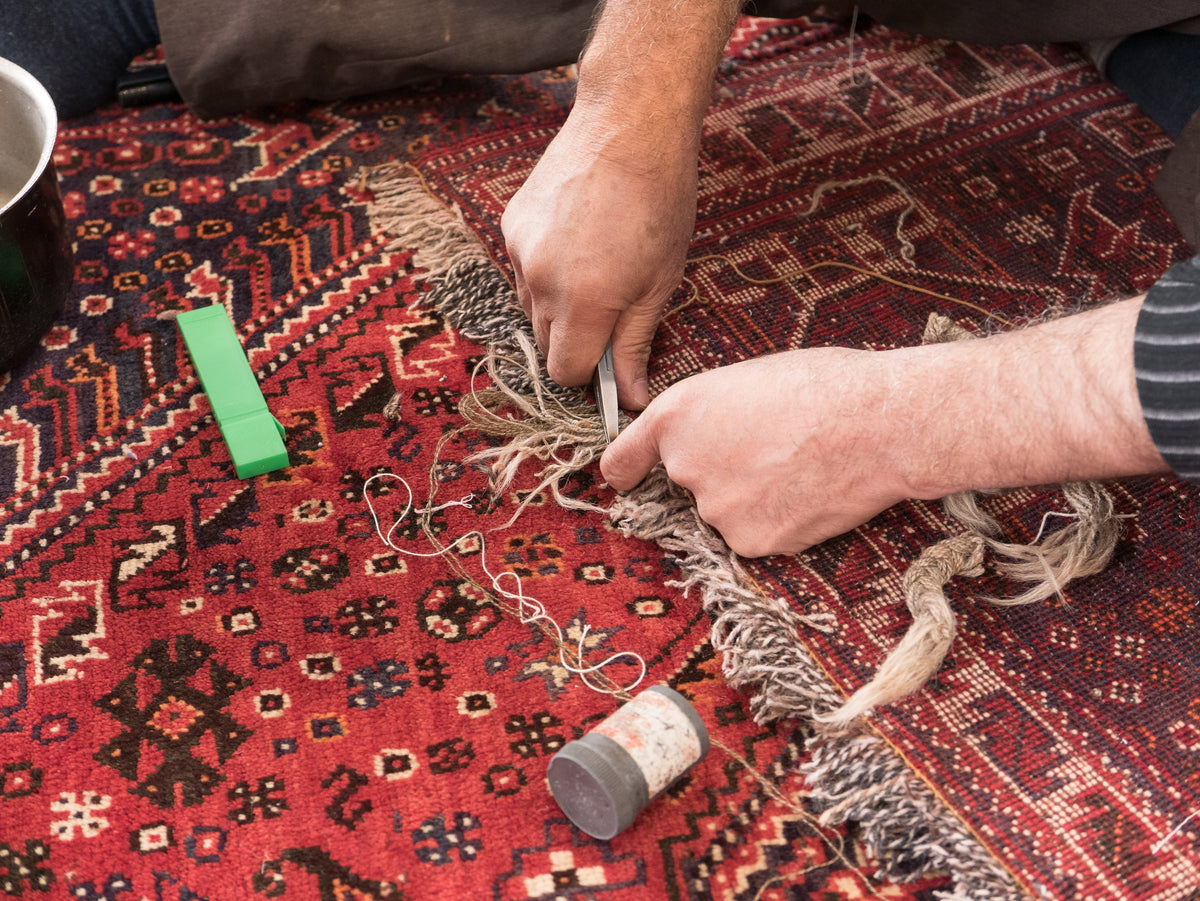
The warp and weft yarns of Lori rugs are traditionally made of new wool, dyed with natural colours and spun by hand. The hand-spun wool gives the Loris their soft surface. Hand-spun wool is always a little irregular. During dyeing, the natural colourants are absorbed to differing degrees. The rug looks livelier for it, with so-called abrasch – shifts between lighter and darker shades. These changes in the tone of the pile yarn always run across the length of the Lori Royal and make the rug less sensitive to soiling. The weft and warp threads of this Lori Royal are made of cotton. This versatile material is tear-resistant and elastic, which makes it particularly well suited to a hard-wearing foundation.
A note on the photos
Child labour? No thanks.

The rug trade against child labour: Children belong in school, not at a knotting or weaving loom. For us it therefore goes without saying that we only offer rugs made under fair conditions and without child labour. We place particular importance on good working conditions and tolerate no child labour at our producers.
We are proud to be a member of the Care & Fair campaign against child labour.
The industry-wide campaign CARE & FAIR - the rug trade against child labour was founded in 1994. The initiative has made it its mission to fight the excesses of illegal child labour in the knotting countries and, at the same time, to improve the overall situation of rug knotters and their families in the knotting regions of India, Nepal and Pakistan.
Our goals:
- Ending illegal child labour in India and Pakistan.
- Creating better living conditions for knotters' families.
- Socially responsible production. We only accept goods that have been made under fair conditions. Working with our producers as partners, we want to make clear to them that taking on social responsibility benefits everyone.
Together with Care & Fair we currently support 10 schools, 6 adult education centres and 3 day clinics in India and Pakistan.
Choose options
|
|
14-day home trial |
|
|
Free delivery & returns within the EU |